
MOM PERFUMES / FRAGRANCE NOTE LIBRARY
Coconut
Creamy, milky softness with a waxy tropical-fruit association.
Gourmand fruity
- Creamy
- Milky
- Tropical
- Softly sweet
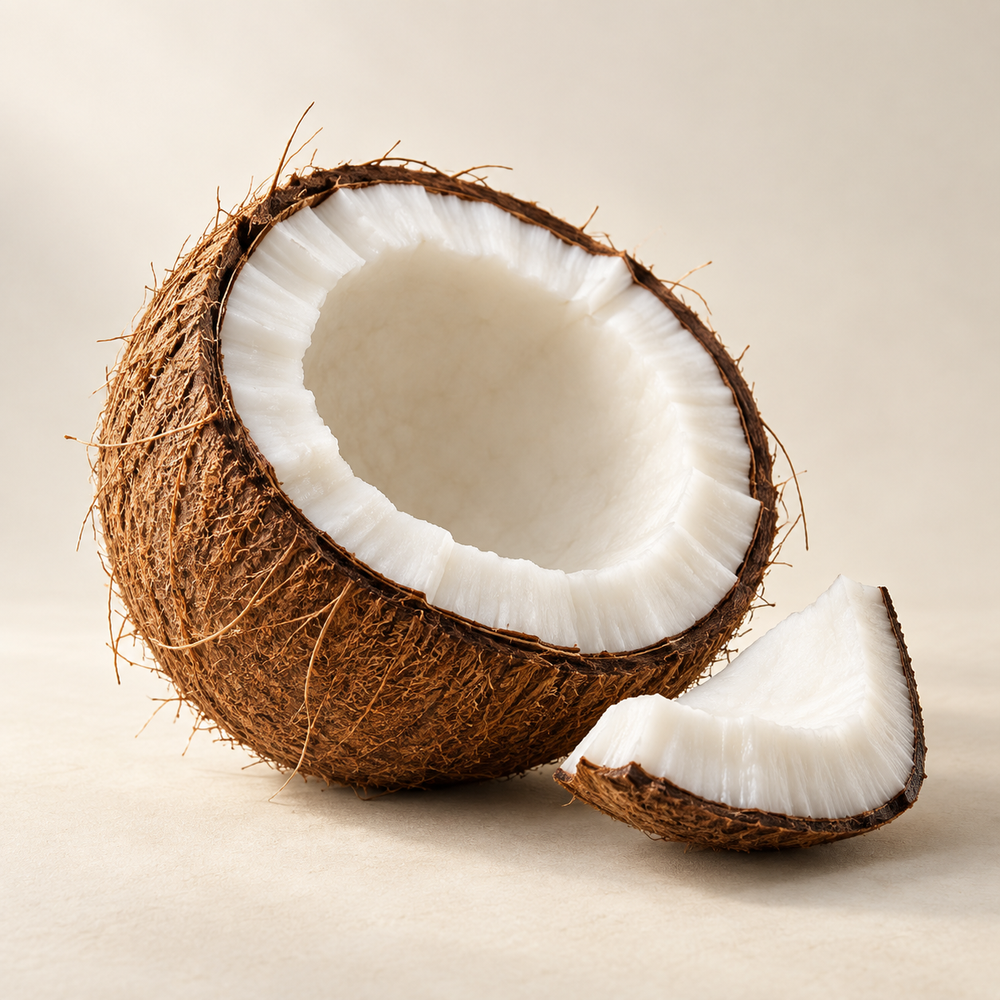
What does coconut smell like in perfume?
Coconut can suggest fresh flesh, creamy coconut milk or a sweeter toasted impression. The texture is often as recognisable as the fruit: milky, rounded and softly waxy. A coconut fragrance may feel tropical, but it can also use only a trace of this creaminess around flowers.
An accord rather than proof of coconut oil
The coconut note describes an aromatic effect. It does not establish that coconut oil supplies the fragrance. A perfumer can use coconut-smelling aroma materials and shape them into fresh, creamy or gourmand directions.
Gamma-nonalactone is one useful tool
Gamma-nonalactone is a documented aroma material with coconut, milky and waxy facets. It is historically sold under names including Aldehyde C-18. Despite that trade name, it is a lactone, not an aldehyde. Material identity is more reliable than a familiar commercial nickname.
Three textures, not extraction grades
These cards describe ways the accord can be presented. They do not imply that fresh flesh, milk or toasted coconut was processed into the bottle.
Fresh coconut
Look for a lighter fruit impression with less confectionery sweetness.
Creamy coconut
Focus on milky roundness and a soft waxy texture. Creamy is a smell association, not evidence of dairy.
Toasted coconut
Look for a warmer, browned or dessert-like context around the coconut impression.
The accord is made, not harvested as a single material
There is no single country, coconut variety or pressing method behind every coconut note. The plant shown in an illustration is the inspiration; the aroma materials have their own supply chains. Assigning a tropical growing region to the accord would overstate what the note list tells us.
Creaminess beyond an obvious beach scent
The supplier documents gamma-nonalactone’s use with fruit materials and rich flowers such as jasmine and tuberose. It can add creamy texture without turning a fragrance into a literal coconut portrait. A stronger coconut association is a compositional choice, not the only use of the material.
Compare creaminess with sweetness
Beside vanilla, ask whether coconut brings a milkier texture beyond shared sweetness. With white flowers, notice whether it seems part of the petals or a separate fruit. With dry woods, look for a contrast between smoothness and dryness. These observations help distinguish styles without identifying an undisclosed ingredient.
Go deeper
Is Aldehyde C-18 actually an aldehyde?
No. In this context the historical name refers to gamma-nonalactone. The mismatch is a useful example of why trade names are not chemical classifications.
Does coconut prove a natural coconut extract?
No. The note can be constructed with aroma materials. A realistic smell is not a sourcing certificate.
Must every coconut perfume smell like sunscreen?
No. Familiar product associations influence recognition, but the same creamy facet can appear in floral, fruity or woody contexts.
Explore combinations
Ideas for exploring scent; related notes are not necessarily synonyms.
-

Tuberose
Explore Tuberose → -

Benzoin
Explore Benzoin → -

White musk
Explore White musk →


Related notes
Ideas for exploring scent; related notes are not necessarily synonyms.
-

Pineapple
Explore Pineapple → -

Praline
Explore Praline →


Perfumes containing this note
Selected from MOM's structured fragrance profiles for this exact note. A listed note describes the fragrance and does not disclose its formula.
-

Lattafa - Yara Tous Eau De Parfum 100ml
₹2,455.00
Available View fragrance -

Nishane Fan Your Flames Extrait De Parfum 100 ML
₹14,300.00
Available View fragrance -

Nishane Fan your flames Extrait de Parfum
₹10,500.00
Available View fragrance -

Ahmed Al Maghribi- AHL 60ML EDP
₹4,500.00
Available View fragrance -

Ahmed Al Maghribi Brulee 100ml
₹3,450.00
Available View fragrance -

Ahmed Al Maghribi Kaffe Latte 100ml
₹2,600.00
Available View fragrance -

Ahmed Al Maghribi Niswah 75ml
₹4,450.00
Available View fragrance -

Rasasi Hawas Tropical For Men & Women 100ML EDP
₹2,899.00
Available View fragrance -

Khadlaj Island Sun Extrait de Parfum
From ₹530.00
Available Available in a 10 ml decant. View fragrance -

Khadlaj Cloud Candy Extrait de Parfum
From ₹480.00
Available Available in a 10 ml decant. View fragrance -

Khadlaj Fursan White EDP
From ₹470.00
Available Available in a 10 ml decant. View fragrance -

Khadlaj Island Extrait de Parfum
From ₹500.00
Available Available in a 10 ml decant. View fragrance -

Khadlaj Musk Al Sabah EDP
From ₹450.00
Available Available in a 10 ml decant. View fragrance -

Khadlaj Nuha EDP
From ₹488.00
Available Available in a 10 ml decant. View fragrance


Research and transparency
Sources explain the materials and scent effects discussed above. Supplier descriptions refer to their own materials; pairing exercises are MOM editorial suggestions. Product discovery retains the existing verified note relationships.